
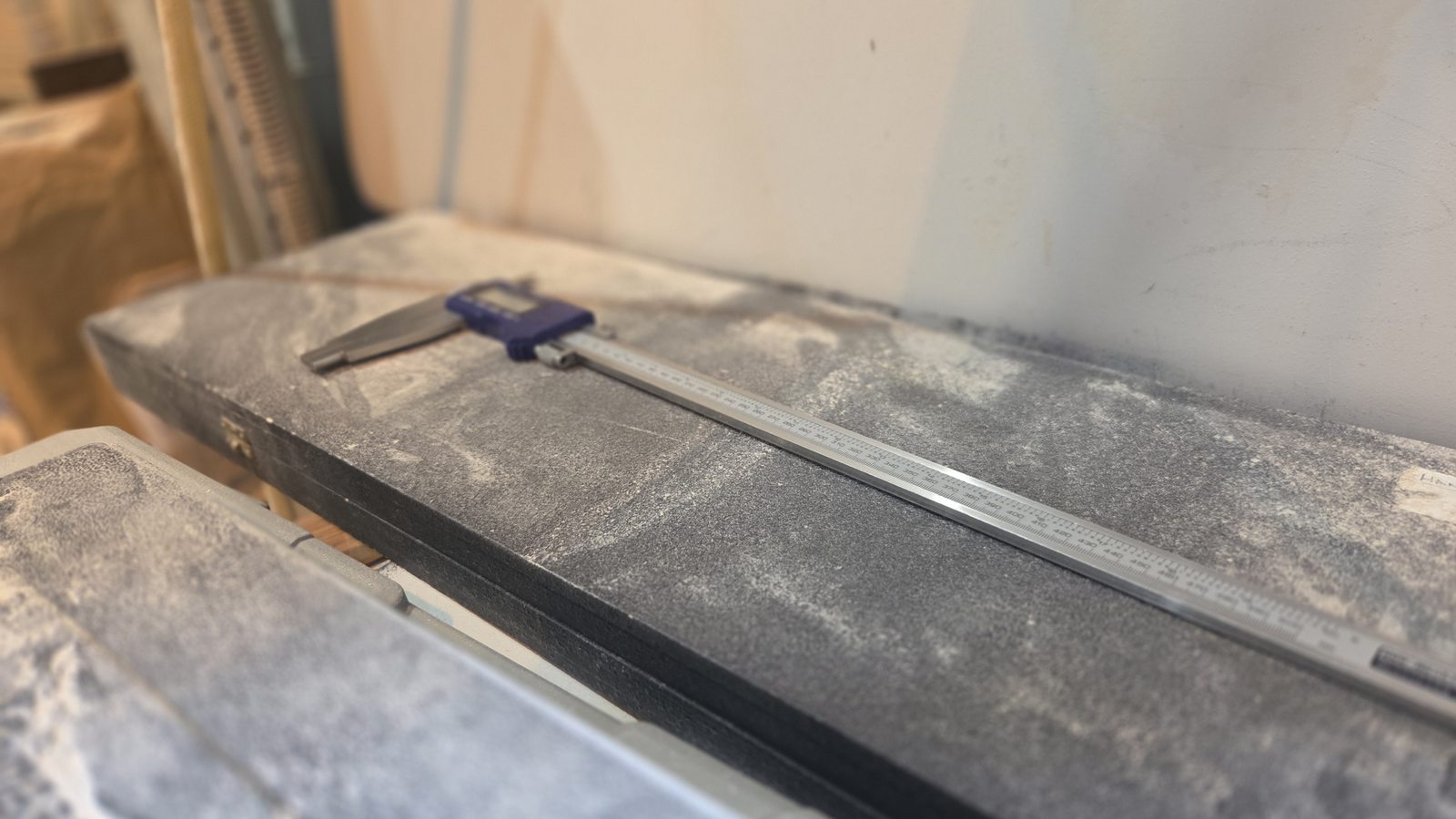
Half a millimetre. You cannot see it with your eyes. You can hear it in a speaker cabinet.
Tolerances are one of those topics that sound abstract until you put them up against the finished product. People hear the word "tolerance" and think of a spec sheet. I hear it and think about the last time a cabinet came back to us because the tuning was off, and the hours of diagnosis it took to trace the problem back to a panel that was slightly larger than it should have been.
In cabinet manufacturing, tolerances are not a detail. They are the difference between a cabinet that performs to specification and one that almost does. Almost is a word that has no place in professional audio.
Why tolerances matter in an enclosure
A speaker cabinet is a designed acoustic volume. The internal air space is tuned deliberately. The designer has calculated a specific volume that produces a specific behaviour from the driver loaded into it. If you shrink that volume, the bass response shifts one way. If you enlarge it, it shifts the other way. Neither of those is what the engineer specified.
Then there are the panels themselves. Every joint has to mate cleanly. Every seam has to seal airtight because a leak inside a bass enclosure is a tuning error waiting to happen. Every fastener has to land on solid wood, not a chipped edge. The hardware has to sit flush. The bracing has to bridge between panels without gaps.
All of that depends on dimensional accuracy. And dimensional accuracy is measured in tenths of a millimetre, not whole ones.
A practical example: the port
Let me give you a concrete example. A bass-reflex cabinet uses a port, which is a tuned vent that extends the low-frequency output of the driver. The port length is specified to achieve a particular tuning frequency. Get the length right, and the cabinet behaves exactly as the designer intended.
Now imagine the port is cut two millimetres longer than the drawing. It does not sound like much. It is smaller than the head of a pencil. But a 2mm error on a port shifts the tuning frequency, which shifts the acoustic output, which shifts the whole low-end character of the cabinet.
The audience will not point at a cabinet and say "the port is 2mm too long." They will say it sounds wrong, or that the bass feels loose, or that there is something off about the system they cannot quite describe. The engineer monitoring the show will hear it immediately. And by then, the cabinet is already on the truck, already in the venue, already a problem that has to be solved at the wrong end of the supply chain.
How CNC holds the line
This is where CNC machining becomes indispensable. A CNC router holds position to fractions of a millimetre, all day, on every cut, across every sheet. It does not get tired. It does not eyeball a measurement. It does not cut on a Friday afternoon any differently to how it cuts on a Monday morning.
And the tolerances are verifiable. We can measure a cut panel against the drawing and know whether it is within spec. If a panel is out, we know immediately. We do not find out three weeks later when the cabinet fails a listening test.
Hand cutting at production scale cannot match this. That is not a criticism of handwork, which has its place in the workshop, and which I have enormous respect for. It is a statement of fact. A human being with a saw cannot hold plus-or-minus 0.1mm across hundreds of panels a day. The machine can. And for a manufacturer that needs to deliver dozens or hundreds of identical cabinets to a touring rig spec, the machine is the only answer.
The move to CNC was one of the most significant investments this business has ever made, and it is the reason we can promise the consistency we do. Not because the operators are less skilled. Because the tolerances the market now expects are beyond what even a very skilled hand can repeat reliably at volume.
Tolerances are not a manufacturing detail. They are the difference between a cabinet that performs to specification and one that almost does.
The cost of almost
When a tolerance slips, the cost does not show up on the invoice. It shows up in the return visit. In the engineer who loses confidence in the system. In the comparison test where two cabinets that should sound identical do not. In the quiet conversation where the client says the last batch was not quite right.
Those are the costs that hurt. None of them are easy to quantify, and all of them matter more than the price of the raw material.
This is why we treat tolerance as a first-order discipline, not an afterthought. It is why we measure and verify. It is why we do not wave something through because it is "close enough." Close enough is the cousin of almost, and both of them will eventually cost somebody a gig.
Half a millimetre. Invisible to the eye. Audible in a cabinet. And entirely avoidable if you build to the drawing.