
If someone tells me their speaker cabinets are made from plywood, my first question is always the same. Which plywood?
It sounds pedantic. It is not.
The word "plywood" covers a range of products so wide that using it as a single category is almost meaningless. At one end of the scale, you have construction sheet goods full of voids, knots, patched layers, and inconsistent core density. At the other end, you have precision-graded Baltic Birch, which is a completely different material built to a completely different standard. Treating the two as interchangeable is the single most common misunderstanding I encounter, and it is the one that causes the most damage when it goes unchecked.
What actually makes Baltic Birch different
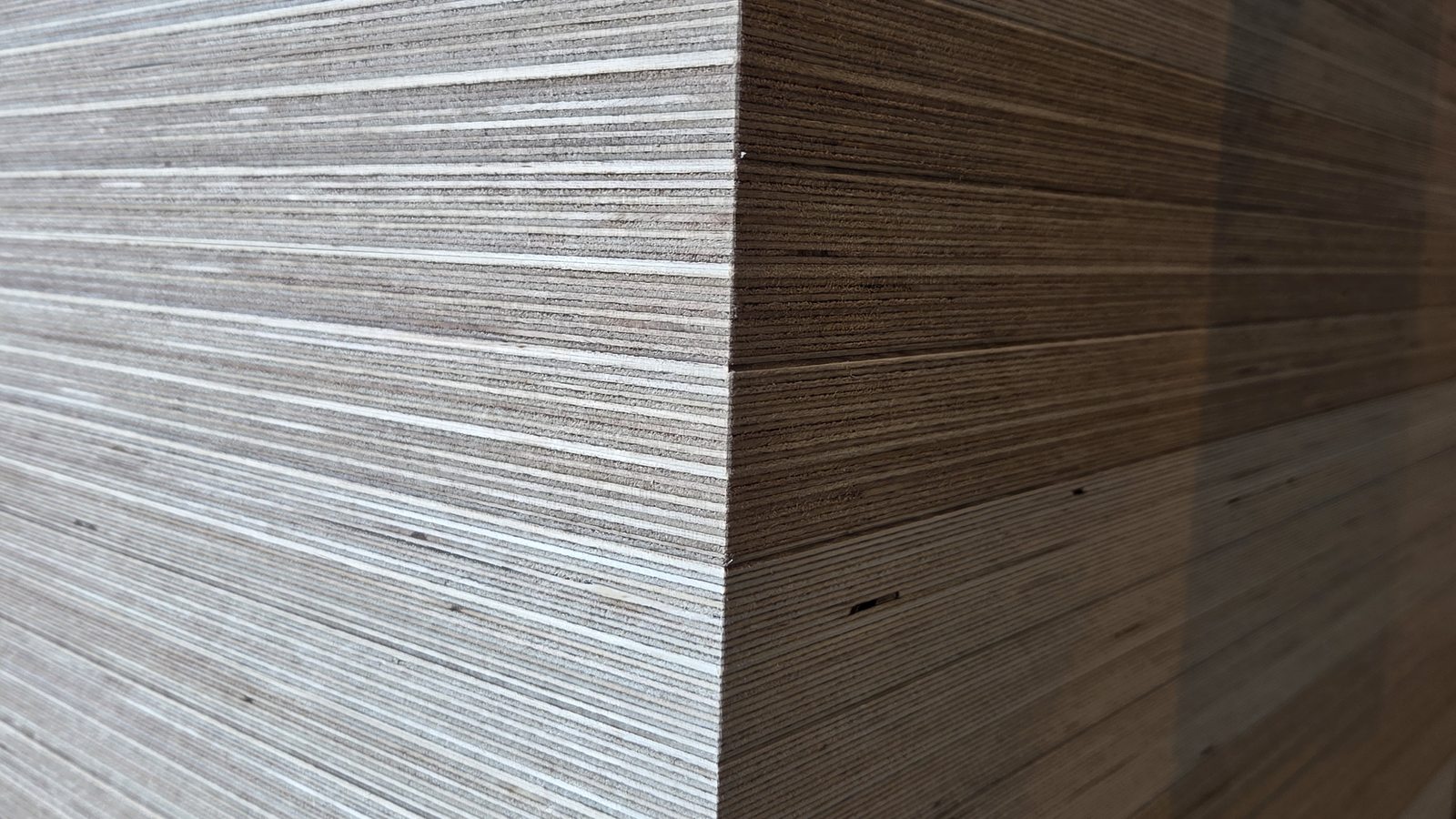
Baltic Birch is an all-birch panel. Every ply, from the face veneers to the innermost core layers, is birch. That matters because the density and stiffness of the panel are consistent all the way through. There are no softwood fillers, no cheaper species hiding in the middle, no surprises when the CNC router breaks into the core.
The second difference is void content. A decent Baltic Birch sheet has a uniform, tightly bonded core with minimal voids. Standard construction plywood can have voids that you only discover when you cut into them, at which point the panel edge is ruined and the structural behaviour of the sheet is no longer predictable. For a speaker cabinet, where every joint and every panel edge has to seal airtight and hold precise geometry, voids are not a cosmetic issue. They are a structural one.
The third difference is density. Baltic Birch is heavy for its thickness. That weight is not waste. It is mass, and mass is exactly what you want in a cabinet wall that has to resist resonance and keep unwanted vibration out of the sound.
Why the pro audio industry specifies it
Walk round any serious loudspeaker manufacturer in the world, and you will find Baltic Birch in the workshop. It is the default material for professional speaker cabinets, and it has been for decades. There is a reason for that, and it is not tradition. It is because the material behaves in a way that can be modelled, predicted, and trusted across a production run.
Consistency is the word that matters. If I cut a panel from one sheet and a panel from the next sheet, they should machine the same, glue the same, and sound the same. Commodity plywood cannot promise that. Baltic Birch can.
MDF gets mentioned in the same conversation sometimes, and it is a perfectly reasonable material for certain applications. Hi-fi cabinets use it successfully. Some installation work uses it. But it is heavier, it does not take screws or fasteners in the same way, and when it meets moisture it loses its structural integrity fast. For a cabinet that has to fly in and out of trucks, sit on damp concrete in load-in bays, and get re-rigged in venue after venue, it is the wrong tool for the job.
The engineering analogy
Engineers do not say "it's made of metal" when they specify a bridge. They say the grade. They specify the alloy, the treatment, the tolerances, and the finish. That precision of language is how serious engineering gets done, because the word "metal" on its own tells you almost nothing about how the thing will behave under load.
Speaker cabinets are the same. Saying "it's made of plywood" tells you almost nothing. What matters is which plywood, what grade, what core structure, and which supplier it came from. Two panels that look identical on the outside can perform very differently once you start asking them to hold tolerances, seal joints, and resist the fatigue cycles of life on a touring rig.
The material is the foundation of everything that follows. Get it wrong, and nothing downstream can fix it.
Why we care so much about this
Because the material is the foundation of everything that follows. Get it wrong, and nothing downstream can fix it. Not the CNC programming, not the bracing, not the assembly care, not the finish. A cabinet built on inconsistent plywood will always fight you. One panel will machine clean, the next one will tear out. One joint will seal, the next one will whistle. One sheet will hold its shape, the next one will move on you a week later.
Precision manufacturing starts with precision materials. Everything else is downstream of that choice. When a client asks us why we are particular about the grade of panel we work with, this is the answer. It is not snobbery and it is not cost. It is the only way to build a cabinet that will still be performing to specification in ten years.
So the next time someone tells you their speaker cabinets are made from plywood, ask them which one. Their answer will tell you a lot about what they are really selling.