
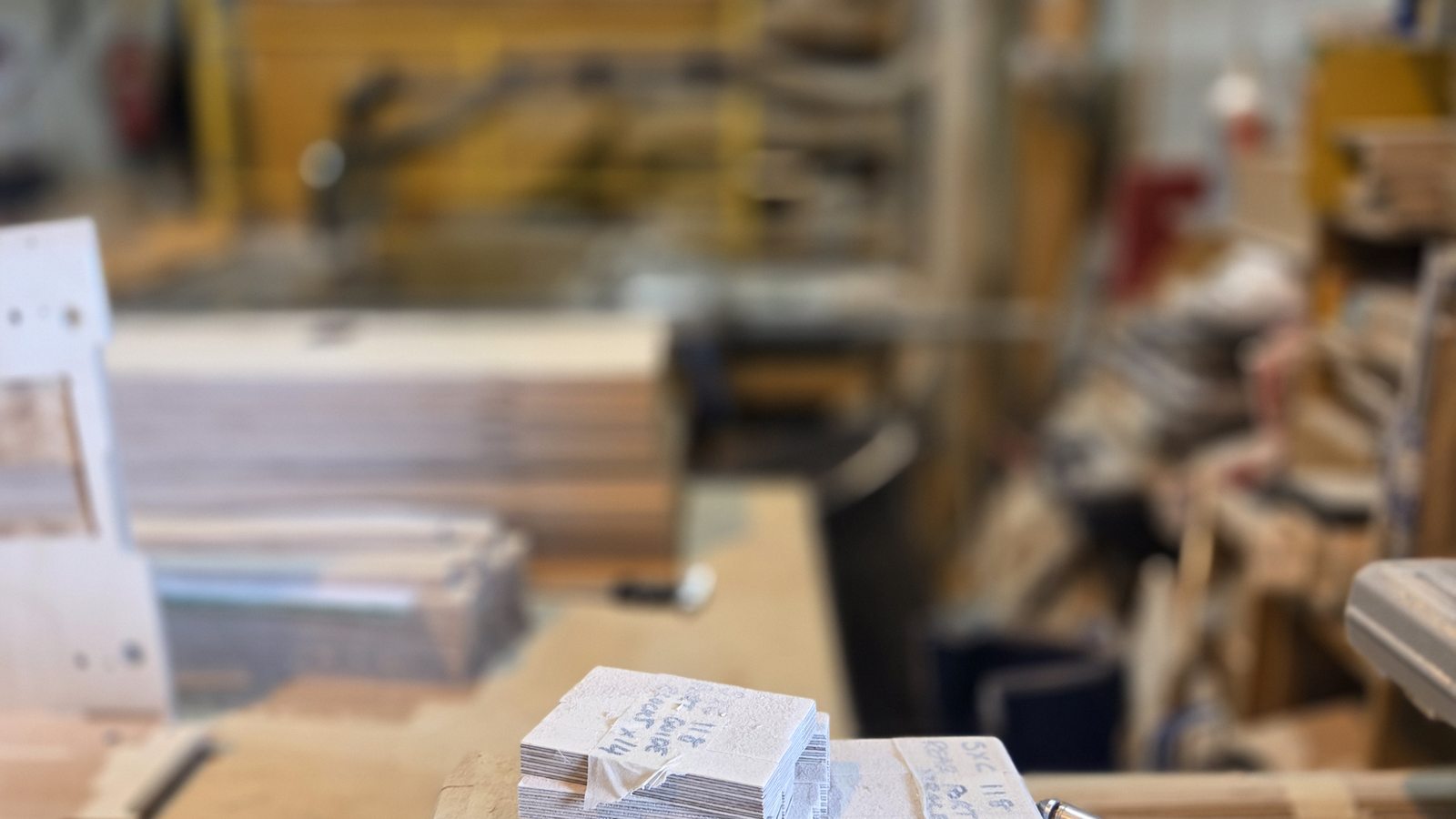
Before a single production panel is cut, a test cut is run. Every time, without exception. It is one of the simplest disciplines in the workshop and one of the most important.
People sometimes assume the test cut is a formality. A box you tick on the way to the real job. It is not. It is the moment where a programme either earns its place on the floor or gets sent back for adjustment.
I want to explain what we are actually looking for when we run one, because it is more than most people outside CNC manufacturing think.
The setup
A test cut is straightforward in principle. You take a sample panel from the same batch of Baltic Birch that will be used in production, you load the programme that has been written for that part, and you run it under the same conditions you intend to use for the full job. Same tooling, same feed rates, same fixturing.
What comes off the bed is a single panel. Then the work begins.
What we measure, and what we look for
The first thing is dimensional accuracy. Every critical dimension on the part is measured against the drawing. Length, width, the position and diameter of every hole, the depth of every pocket, the radius of every internal corner. We are not just checking that the numbers are within tolerance. We are checking how far inside the tolerance band they sit, because a part that lands consistently at the edge of tolerance is a part that will sometimes drift over it.
Then we look at the edges. Edge tear-out is one of the clearest signals a CNC programme can give you about what is going wrong. A clean edge with sharp arrises tells you the feed rate is right and the tooling is fresh. A fuzzy edge tells you the feed is too aggressive for the cutter, or the cutter is starting to dull. A chipped edge tells you the climb-versus-conventional pass is wrong for the grain direction. None of that is in the programme. All of it is in the panel that comes off the bed, if you know how to read it.
Surface quality is next. The face of a Baltic Birch panel should look uniform under a raking light. Any chatter marks, any stepped passes, any inconsistency in the finish, that is the machine telling you something is not right with the spindle, the rigidity of the setup, or the path the toolpath is taking through the part.
Finally, the dry assembly. We take the test cut panel and check it against the mating parts it is supposed to fit. A tongue should slide into its groove with the right amount of friction. A rebate should sit flush against its partner without any rocking. A hole should accept its insert without enlarging and without splitting the surrounding ply. If any of those checks fail, the programme has a problem that the dimensional measurements alone would not have caught.
What a failed test cut tells you
There are really only three reasons a test cut comes back wrong. The programme needs adjustment, in which case we go back into the CAM software and re-tune the toolpaths. The tooling needs changing, in which case we replace whatever cutter has been doing the work and run the test again. Or the material itself has properties that differ from previous batches, which is rare with Baltic Birch but possible, particularly with moisture content and ply consistency.
Working out which of those three is the cause is a matter of looking at the evidence. A dimensional drift across a whole axis points at the programme. Sudden tear-out where the previous batch was clean points at the tooling. Inconsistent surface behaviour across panels from the same sheet points at the material.
In thirty-five years I have seen all three, sometimes in combination. The discipline is not in being clever about diagnosing the cause. It is in stopping the work, taking the time to look properly, and not pressing on with a programme that has not earned its place.
A test cut costs one sheet of material and thirty minutes. Skipping it can cost an entire production run.
Why we will never skip it
There is always pressure to move faster. New programme, tight delivery, client waiting, job already late. The temptation to load a sheet and go straight into production is real. I understand it.
But every workshop that has ever skipped a test cut has a story about the day they wished they had not. A whole batch with a hole in the wrong place. A run of panels that did not assemble properly because nobody noticed the rebate was a degree off. A spindle that was on its last legs and ruined the surface of forty parts in twenty minutes. The cost of those mistakes, in scrap and rework and a delivery that slips by a week, is always larger than the cost of doing the test cut in the first place.
A test cut costs one sheet of material and thirty minutes. Skipping it can cost an entire production run. That is a maths problem with only one sensible answer, and it is the reason every new programme in our shop, without exception, starts with a single panel.