
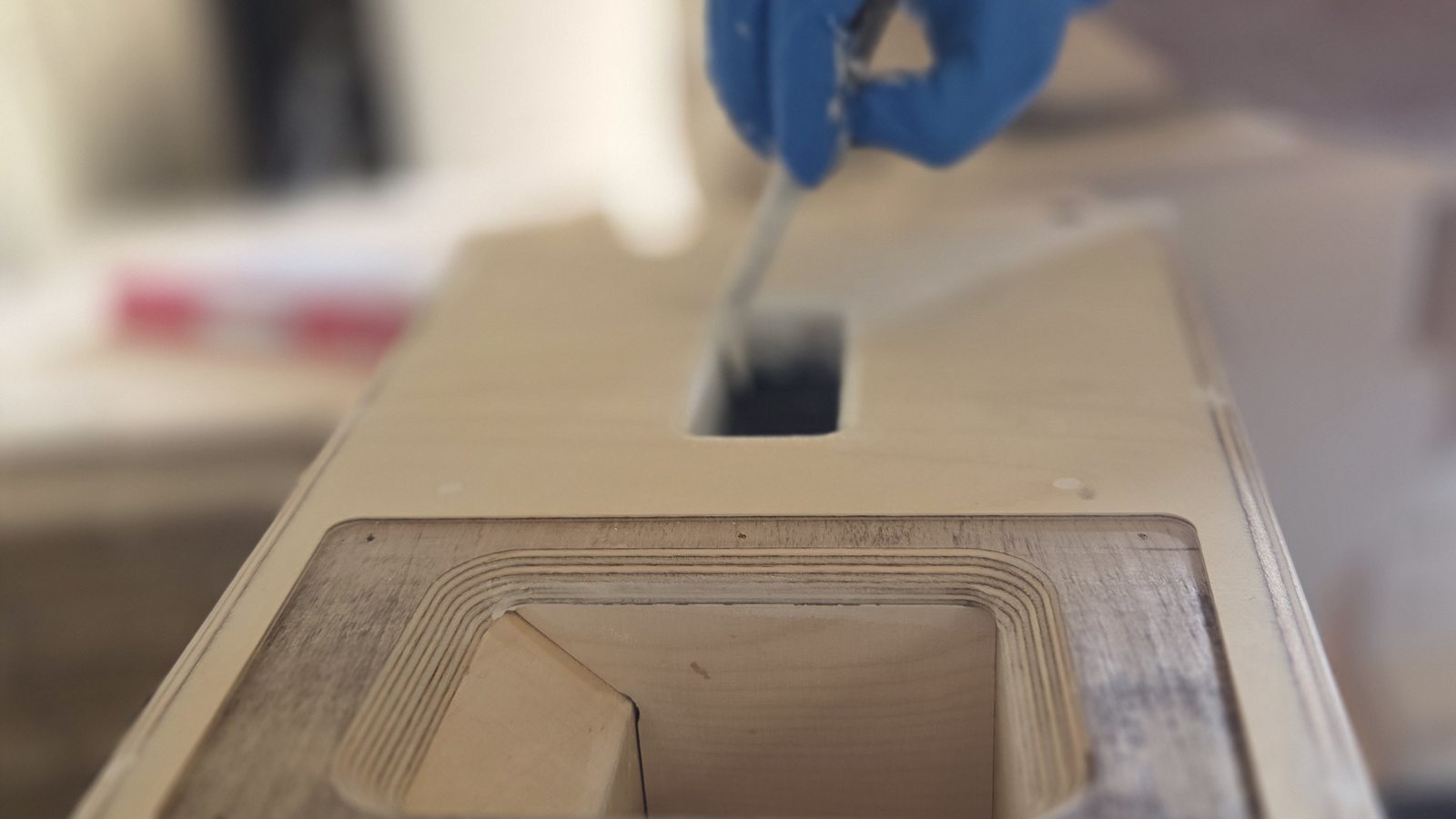
An air leak in a sealed speaker cabinet is not a cosmetic issue. It is an acoustic failure. The cabinet will not perform to specification, and no amount of careful work elsewhere will recover what the leak has taken away.
I have been telling people this for thirty-five years. It is still the single thing I find that engineers new to cabinet manufacturing under-respect. They think the air seal is a nice-to-have. It is not. It is the whole job.
Let me explain why.
What a sealed cabinet actually is
A sealed cabinet, or a ported one, is a precisely tuned acoustic system. The driver moves back and forward, and as it moves it compresses and rarefies the air inside the enclosure. The volume of that air, the stiffness it presents back to the driver, and the way it interacts with any port opening, all combine to set the cabinet's response.
The acoustic designer models that system before a single panel is cut. They choose the internal volume to match the driver's parameters. They choose the port dimensions to put the tuning frequency where they want it. The cabinet you build is the cabinet they modelled, only if the air inside it behaves the way they assumed it would.
An air leak changes the effective volume. It introduces a path that was not in the model. It bleeds pressure where pressure should be building up. The cabinet that comes out of the workshop is no longer the cabinet on the spec sheet. It is a different cabinet, with a different response, and nobody asked for it.
Where the leaks actually happen
Leaks do not happen where most people look first. They happen in the places you trust.
Panel joints are the obvious culprit, and a cabinet with poor adhesive coverage along an edge will leak. So will a cabinet with bracing that has been forced into position rather than bonded properly. So will a cabinet where the panel material has a small void or delamination that you cannot see from the outside.
Driver mounting faces are the next problem. A driver bolts onto the front of the cabinet through a gasket. If the gasket is the wrong specification, or if the mounting holes are not perfectly flat, the gasket will not seal evenly and the cabinet will breathe through the bolt holes.
Input plates are the third. The plate where the speaker cable enters the cabinet has its own gasket and its own four screws. Get any of those wrong and you have a leak.
Port seams are the fourth. A port that is glued together from multiple sections has joints, and any of those joints can leak. The leak will be invisible to the eye and audible only as a degradation of the cabinet's tuned response.
That is four families of potential leak per cabinet. Every one of them has to be checked, every time.
How we test for it
We test airtightness on every cabinet that comes through the assembly line. The principle is simple. You introduce a known pressure into the cabinet and you measure how long it takes for that pressure to decay. A cabinet that holds pressure within tolerance is sealed. A cabinet that loses pressure too quickly is not.
What the test catches is anything from a missing bead of adhesive on a single panel edge to a poorly seated gasket on the input plate. The test does not tell you where the leak is. It tells you that there is one. Finding the leak is then a manual job, and it always has been.
When a leak is found, the cabinet goes back to the bench. It does not get patched on the line. It does not get waved through with a note. It goes back, the leak is identified and corrected, and then the cabinet is tested again. This is non-negotiable, and it has been non-negotiable for as long as I have been doing the job.
You cannot tune a cabinet that leaks. It is as simple as that.
Why this matters more in some designs than others
Airtightness is critical for every cabinet, but it is doubly critical for bass-reflex and bandpass designs. Those designs depend on the precise interaction between the internal volume, the port, and the driver. A leak in a bass-reflex cabinet does not just shift the response, it can change the phase relationship between the port output and the driver output, and the result is a cabinet that sounds wrong in a way the customer cannot articulate but will not buy.
Bandpass cabinets are even more sensitive. A bandpass design uses two chambers, each with its own carefully calculated volume, and the relationship between them defines the entire passband. A leak in either chamber unbalances the system. The cabinet stops doing what it was designed to do, and there is no listening test, no equalisation, no amplifier setting that can put it back.
The most demanding designs are also the least forgiving of poor sealing. The cabinets that the most discerning brands ask for are the cabinets where the seal has to be perfect.
That is the standard we work to. Not because it is heroic. Because it is the only standard that produces a cabinet that does what it was designed to do.
You cannot tune a cabinet that leaks. It is as simple as that.