
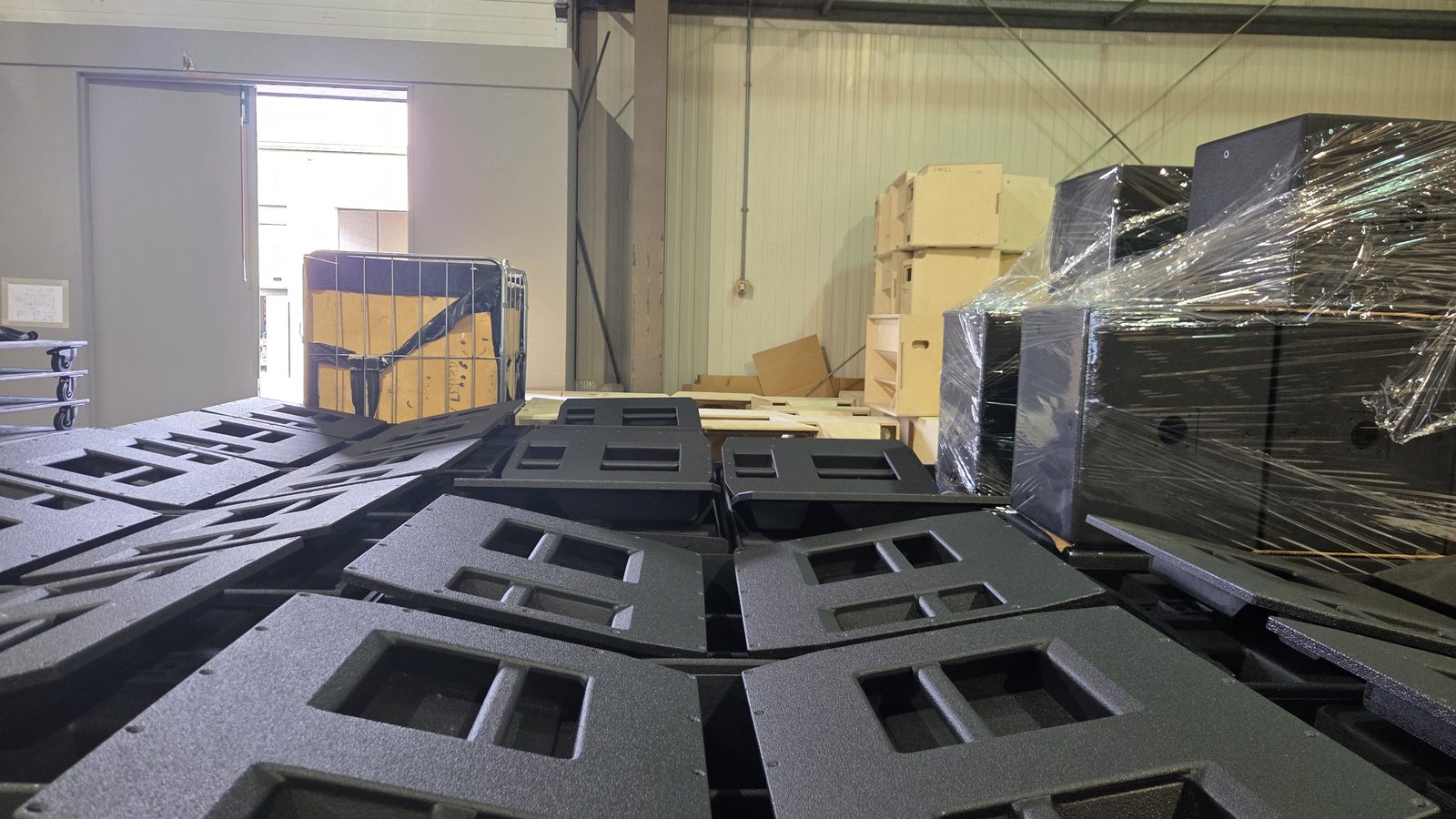
A speaker cabinet that survives our five-stage quality process and then arrives damaged at the other end is a failure of packing, not manufacturing. I have to say that out loud sometimes, because it is easy to forget that the cabinet has a journey to make once it leaves the workshop.
The logistics chain between Calne and a venue on another continent is brutal. We have spent years learning what that journey actually does to a cabinet, and we have spent at least as long learning how to pack one so it survives.
This is what that looks like in practice.
What the freight chain actually does
People imagine freight as a smooth ride on a quiet ship. It is not. A cabinet leaving the workshop on a Tuesday morning will be picked up by a haulier, dropped at a UK consolidation depot, loaded into a container, trucked to a port, lifted onto a ship, lifted off again at the destination port, trucked to a destination depot, broken out of the consolidation, loaded onto another vehicle, and finally delivered to the venue or installer.
That is a minimum of six handling stages, each with its own forklift drivers, its own warehouse stacking, and its own opportunity to put the cabinet on the wrong way up.
Add to that the temperature variation between a cold UK warehouse and a hot tropical port, the humidity changes inside a sealed container at sea, and the constant low-frequency vibration of road and rail. The cabinet you packed and the cabinet that arrives are not in the same condition unless you have planned for every one of those stages.
Different shipments, different specifications
A UK road shipment is packed differently from a sea freight consignment. That is the most basic rule, and it is the one most often ignored.
For a UK road delivery, the cabinet needs corner protection, surface protection, and enough rigidity in the outer pack to survive being stacked. Moisture is rarely a serious risk.
For a sea freight consignment, you are dealing with weeks at sea inside a metal box that swings between cold and hot, dry and humid. The pack needs a moisture barrier. It needs internal desiccant. It needs to survive being stacked under heavier crates without crushing. It needs to be sized so the freight forwarder can stack it efficiently inside the container, because a badly sized pack is a stacking nightmare and stacking nightmares are how cabinets get damaged.
For an air freight consignment, weight matters more than anything. You are paying by the kilo, so the pack has to be as light as it can be while still doing its job. That is a different optimisation problem entirely.
Each of these has a different specification, and we write that specification at the order stage, not the despatch stage.
What we have learned from the cabinets that did not make it
I am not going to name clients, but I will say that the lessons we have learned about packing have come from the cabinets that arrived damaged. Every one of those is a problem we will not repeat.
We have learned that corner protection has to be denser than it looks. We have learned that the strapping that holds the cabinet inside the pack matters more than the pack itself. We have learned that orientation labels are useless because handlers do not read them, so the pack has to be designed to survive being put on its side. We have learned that cabinets stacked next to refrigerated cargo can pick up surprising amounts of condensation, even inside a moisture barrier, if the barrier is not specified correctly.
None of that is in a textbook. All of it is in our packing specifications now.
Packing is the sixth stage of our process. We just do not put it on the wall.
The real cost of getting it wrong
A damaged cabinet is the obvious cost. The replacement, the freight back to the workshop, the freight out again. That is the line item on the invoice and it hurts.
But it is not the biggest cost. The biggest cost is the installation that does not happen on time. The venue that opens without its main system. The tour that has to play with a borrowed rig because the right one is sitting on a dock somewhere with a cracked corner. The brand whose customer is now wondering whether to use a different supplier next time.
That is the cost we are really packing against. The cabinet is replaceable. The deadline is not. The reputation is not.
So when someone asks why a single cabinet leaves our workshop in what looks like an over-engineered crate, the answer is that the crate is doing the job that the next six handlers are not going to do for us. The cost of the crate is a fraction of the cost of getting it wrong.
Packing is the sixth stage of our process. We just do not put it on the wall.