
Thirty-five years. One partnership. That is not a contract. That is a relationship.
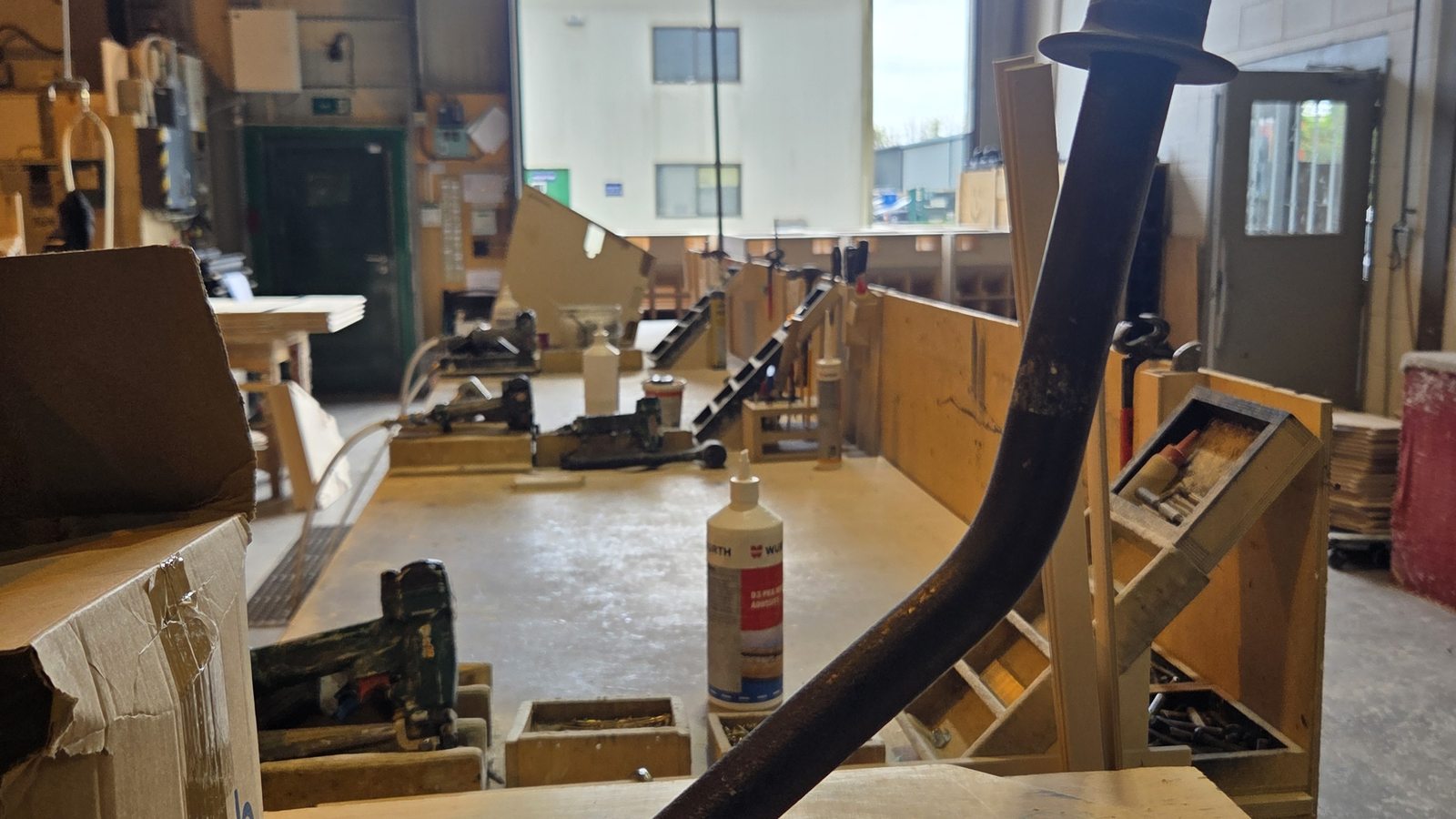
We have been building cabinets for the same client since 1991. Through three economic cycles, two changes of premises on their side, several generations of products, an enormous amount of touring history, and the slow, steady evolution of an industry that looks very different now to the one we started in. The phone still rings. The orders still come. The cabinets still leave our workshop in Wiltshire and start their working lives somewhere out in the world.
Most contract manufacturing relationships do not last that long. I want to talk about what changes when one of them does.
You start to share a language
The first thing that changes is how you talk to each other.
In the early years, every conversation is technical and explicit. The client describes what they want, you confirm what you have understood, you both go away and check, you come back and confirm again. Nothing is assumed. Everything has to be spelled out. That is right and proper, because the cost of a misunderstanding at that stage is a cabinet that does not fit the rest of the system.
After enough years of building together, the conversation gets shorter. Not because anyone is cutting corners, but because the shared vocabulary has grown. When a designer on their side mentions a particular style of brace pattern, we know what it looks like, what it is for, how it has to be fitted, and what to watch out for during assembly. We do not need them to send us a drawing of something we have built four hundred times before.
That kind of shorthand is not laziness. It is a kind of accumulated trust that you cannot buy and you cannot fake. It only exists if you have built it together, slowly, over years.
Quality expectations become implicit
The second thing that changes is the standard.
In a new manufacturing relationship, every quality expectation has to be written into the specification. Tolerances, finishes, fit, the way a panel sits against a baffle, the acceptable range of variation between units. All of it on paper. All of it inspected on receipt. All of it argued about when there is a difference of opinion.
In a relationship that has run for thirty-five years, most of those expectations are implicit. The client knows what we are going to deliver. We know what they are going to accept. The standard is not written on a drawing because it is built into the way we work and the way they look at the cabinets when they arrive. It is the same standard we would apply if no one was looking, because it is the standard we have agreed on for three decades.
Implicit standards are dangerous in the wrong relationships. They go wrong the moment one party assumes something the other did not actually agree to. In the right relationship, where both sides have earned the trust over years of consistent delivery, implicit standards are the most efficient form of quality control there is. There is no specification overhead. There is no inspection theatre. There is just the work, done properly.
You can anticipate what is coming next
The third thing that changes is your ability to see around corners.
After enough years, you can read the client's plans before they arrive. A new product line is coming, you can feel it in the volume of conversations about a particular kind of driver. A redesign of an existing range is brewing, you can tell from the questions about a different bracing scheme. A push into a new market is on the horizon, you can see it in the changes to the rigging hardware specifications.
None of that is intelligence we go looking for. It is just what happens when you have been part of someone's manufacturing supply chain for long enough to feel its rhythm.
What that lets us do is prepare. We can think about how we would build the new product before we have been asked to. We can stockpile the materials we know we are going to need. We can rearrange the workshop in advance of a volume change. By the time the formal request lands, we are halfway to delivering it.
Specification cycles get shorter
There is a practical advantage to all of this that nobody outside manufacturing thinks about until they live through it.
A new product with a new manufacturing partner takes a long time to get into production. There is a specification phase, a sampling phase, a tooling phase, a first article phase, an approval phase, and only then does volume production start. Each phase is a chance for something to go wrong, a difference of interpretation, a tolerance that has to be revisited, a finish that does not look the way the client expected.
A new product with a partner you have worked with for thirty-five years moves through the same phases far more quickly. We already know how the client wants tolerances expressed. They already know what kind of feedback we will give them on a draft drawing. We already know which finishes they prefer for which applications. The conversations are still happening, but they are conversations between two teams that already understand each other.
A specification that might take six months with a new partner can move in a fraction of that time with one you have grown alongside. That speed is real money in a competitive market. It is one of the reasons partnerships of this length survive.
Partnerships of this length are rare in manufacturing. They survive because both sides earn them every day.
Both sides earn it every day
I do not want any of this to sound easy. It is not.
The reason most contract manufacturing relationships do not reach thirty-five years is that one side or the other stops earning it at some point. The supplier gets complacent and the quality drifts. The client tries to squeeze the last few percent out of the unit price and the supplier walks away. A change of management on either side breaks the working rhythm. A market shift forces a reset that neither party survives.
Avoiding all of those is a daily job. We have done it by treating the relationship as the most valuable thing we own, and behaving accordingly. Every cabinet we ship has to be as good as the cabinet we shipped yesterday, and the cabinet they will need from us tomorrow. Every conversation has to leave the client more confident in us, not less. Every problem has to be flagged early and solved together, not buried and discovered later.
None of that is glamorous. All of it is the actual job.
Partnerships of this length are rare in manufacturing. They survive because both sides earn them every day. Thirty-five years on, we are still earning ours, and that is exactly how it should be.