
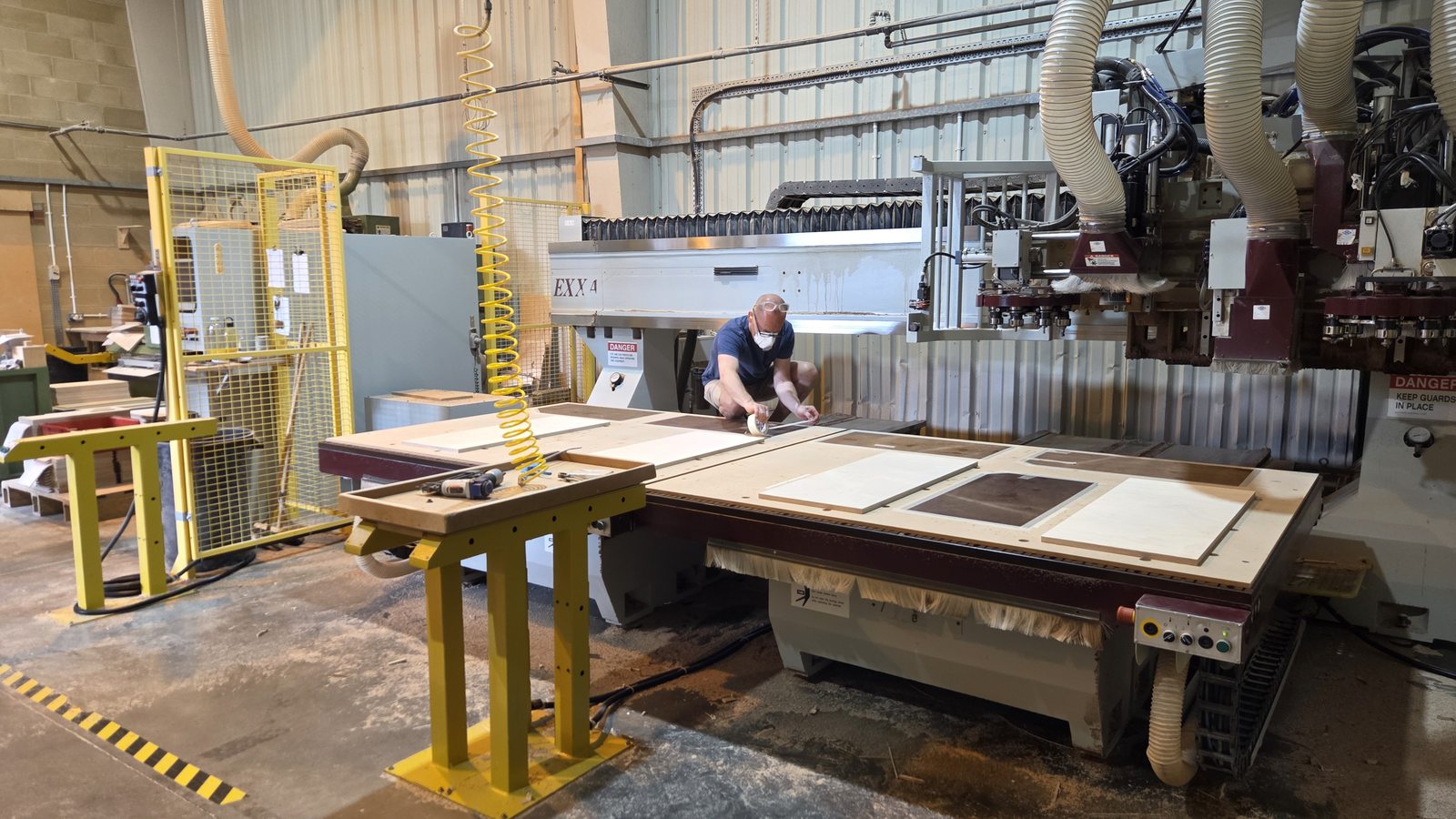
If you have programmed CNC for furniture or construction, you have not programmed CNC for speaker cabinets. The two disciplines share machines and software. Almost nothing else.
I have spent a lot of years watching skilled programmers from other woodworking trades come into a cabinet workshop and run into the same wall. The machines are familiar. The drawings look familiar. The tolerances are not, and the geometry is not, and the consequences of getting it wrong are not.
I want to walk through what makes a cabinet programme different, because the difference is the entire job.
The geometry is not flat
A piece of furniture is mostly orthogonal. Right angles, parallel faces, predictable joints. A speaker cabinet is rarely any of those things.
You are dealing with compound angles where panels meet at deliberate offsets to control internal reflections. You are dealing with internal bracing positions calculated to interrupt standing waves. You are dealing with port geometry that has been designed to a specific cross-sectional area and length, so it tunes the cabinet to a particular frequency. You are dealing with rebates for flush mounting drivers, where the depth has to match the driver flange to a fraction of a millimetre.
None of that is in a furniture programme. All of it has to be in a cabinet programme, and the programme has to hold every dimension across hundreds of cabinets without drift.
The tolerances are tighter than people expect. A driver flange that sits even half a millimetre proud of its rebate will not seal against the gasket properly, and the cabinet will breathe through the bolt holes. A panel edge that is a millimetre short across its length will leave a glue gap that the bond will struggle to fill. These are not aesthetic issues. They are acoustic ones, and they all live in the programme.
And the panels do not exist in isolation. Every cut in the programme has to be considered alongside every other cut, because the cabinet is a stack of related dimensions, not a list of independent ones. A change to the rebate depth on the front baffle ripples through to the internal volume, which ripples through to the port tuning, which ripples through to the bracing positions. Programmers who come from cabinet making for kitchens are used to a world where one panel does not really care about the next one. In our world, every panel cares about every other panel.
A worked example: programming a port
Let me take one element and show you what it actually involves. A bass-reflex port is a tube, open at both ends, with a length and a cross-sectional area chosen to tune the cabinet to a specific resonant frequency. The acoustic designer hands you the tuning. The job of the programme is to deliver it.
That sounds simple. It is not.
The programme has to remove material at the joints where the port meets the panel, so the effective length is correct after assembly. It has to account for the thickness of any internal coating that will be applied to the port walls, because the coating reduces the cross-sectional area. It has to allow for the tolerance stack across multiple assembled panels, because every joint introduces a small variation, and those variations accumulate.
Get the port length wrong by a few millimetres and the tuning frequency shifts. The cabinet that the acoustic designer modelled is no longer the cabinet you have built.
The programme is the source of truth
Once a cabinet is in production, the programme is the only thing that matters. Every panel that comes off the CNC has to be identical to the one before it. Every cabinet that leaves the factory has to behave the same way as every other cabinet of that model.
That consistency is not a happy accident. It is the programme.
If you get the programme right, every cabinet that follows is right. If you get the programme wrong, every cabinet that follows carries the same error, and you do not find out until the cabinets are in the field and the customer is asking why this batch sounds different from the last one.
The cost of a programming error is not one ruined panel. It is an entire production run.
Get the programme right and every cabinet that follows will be right. Get it wrong and every cabinet will carry the same error.
Why our programmes are not for sale
Our CNC programmes are accumulated intellectual property. Some of them have been refined over decades, with adjustments learned from real production runs, real assembly issues, real coating behaviour, and real feedback from the brands we build for.
You cannot buy that on a USB stick. You cannot download it from a software vendor. You cannot hire a contract programmer to recreate it in a week. It is the residue of thirty-five years of trial and error, kept inside the workshop and trusted to a small number of people.
Every time we take on a new cabinet design, the first job is to write a new programme. That programme will be wrong in the first iteration. We will refine it on the bench, on the CNC, and during the first assembly run, until every dimension lands where it should and every tolerance behaves the way it needs to.
Then it joins the library, and the cabinet enters production, and it stays there until the brand asks us to change it.
The programme is the single source of truth for the entire production run. It is also the single most valuable asset in the workshop. We treat it accordingly.