
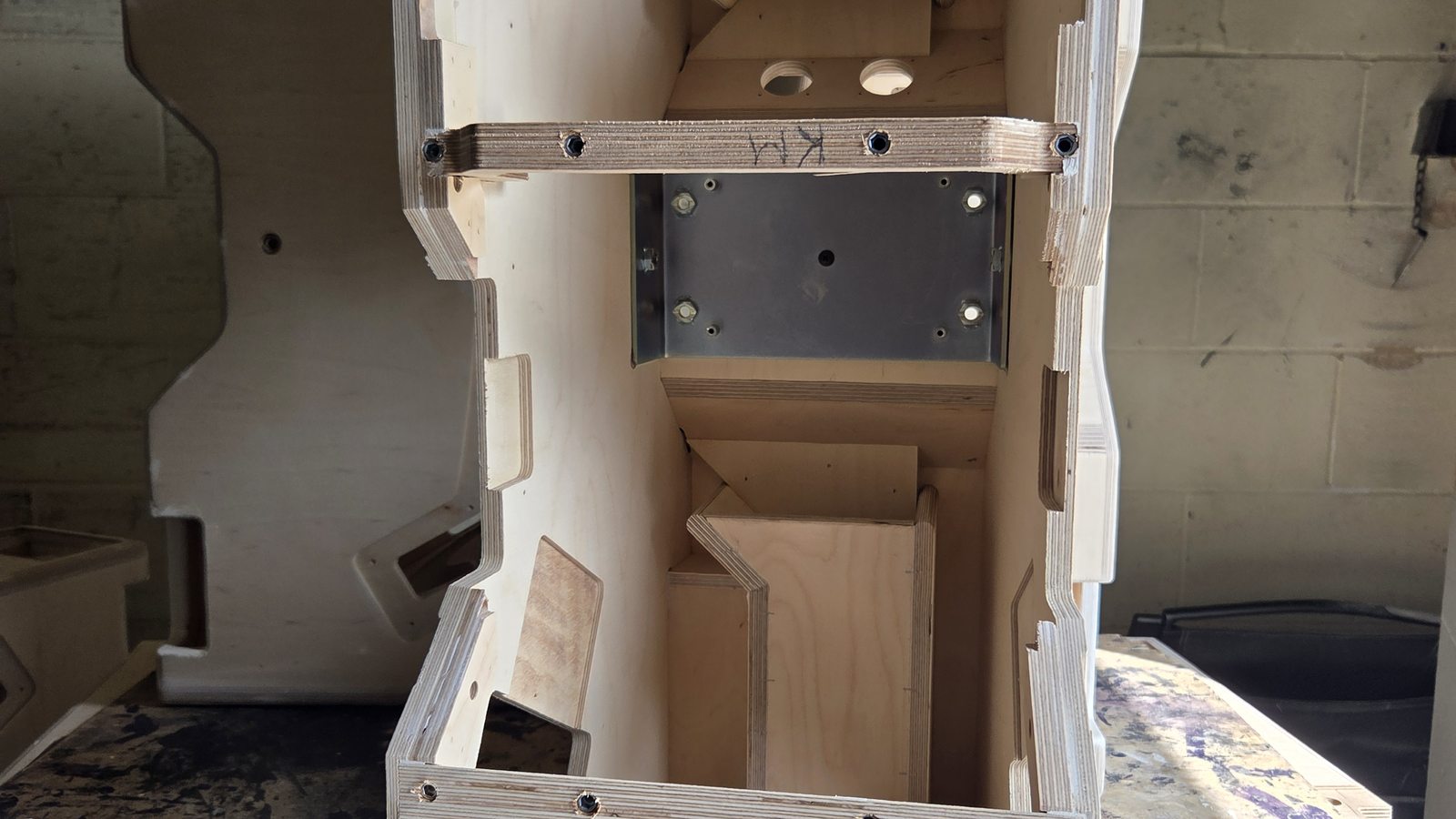
Open a speaker cabinet and the first thing you will see is the bracing. It is also the component most likely to be done badly in a lesser build. After three decades of looking inside cabinets, mine and other people's, I can tell you the bracing tells you almost everything you need to know.
The customer never sees it. The reviewer never photographs it. The marketing brochure never mentions it. And yet it is one of the few components inside a speaker cabinet that, if it is wrong, will quietly ruin the cabinet for as long as the cabinet exists.
I want to talk about why.
What bracing is actually doing
Bracing has three jobs and they are all happening at the same time.
The first is controlling panel resonance. A speaker cabinet panel is a stretched piece of material being driven by air pressure from a moving driver. Without bracing, that panel will sing along with the driver at its own resonant frequencies. The result is a cabinet that adds its own voice to the music, which is the last thing anyone wants. The braces split the panel into smaller sections, each with its own much higher resonant frequency, well above the range where it can colour the sound the listener hears.
The second is structural rigidity. A live touring cabinet gets dropped, stacked, flown from rigging, and trucked thousands of miles a year. The braces tie the panels into one structure so that the loads passing through the cabinet are shared, not concentrated. A cabinet with the right bracing scheme will outlive a cabinet without by a factor of years, in some cases by a factor of decades.
The third is weight distribution. Drivers, ports, rigging hardware, amplifier modules, and connectors all have to attach somewhere. The braces tell those attachments where they can pull from. A brace in the right position lets the driver mount carry its load into the rest of the cabinet without flexing the baffle. A brace in the wrong position can leave the driver mounting flexing on its own, which is a long, slow path to a failure nobody wanted.
Why a few millimetres matter
I have heard people say bracing is bracing. Wood is wood. As long as something is in there, you are fine.
You are not fine.
Moving a brace by a few millimetres changes the resonant modes of the panels it is connecting. The panel sections it creates are different sizes, which means they ring at different frequencies, which means the cabinet's own acoustic signature shifts. On a measurement bench, this is a visible change. In a venue, with the cabinet running, it is an audible one.
Move a brace too close to a port and you start to obstruct airflow. The port will not behave the way the designer modelled it. The bass response will shift, sometimes by a meaningful amount.
Move a brace through the path of an internal standing wave and you can damp the wave or amplify it. Either way, the cabinet is no longer behaving the way the designer intended. The performance the marketing material promises is no longer the performance the customer is getting.
A few millimetres. That is all it takes.
How we position bracing at Sarivale
Every brace position on every cabinet we build comes from the engineering drawing the client has prepared. The drawing has been worked out from the acoustic modelling. Our job is to honour it.
That means three things in our workshop.
First, the brace positions are programmed into the CNC operation that machines the panel housings and joinery. They are not eyeballed at assembly. They are not nudged a few millimetres because something else is in the way. If something else is in the way, we have a conversation with the client and the drawing changes. The brace position is sacred.
Second, the brace positions are verified during assembly. The cabinet maker has the drawing in front of them. They check the position before the adhesive goes on, and they check it again before the first clamp is set. If a brace is even slightly off, the assembly stops and the brace is reset. Adhesive that has started to skin is adhesive that has to come back out, which is a job nobody enjoys, which is why we do not let it get there.
Third, the brace positions are checked one more time before the adhesive sets. A final pass. A final measurement. A final signature on the build sheet. Then the cabinet moves to the next station, and we move to the next cabinet.
Bracing is invisible in the finished product. Its absence is not.
The component nobody sees
The customer who buys the speaker, the engineer who tunes the system at the venue, the audience that hears the show, none of them will ever see the bracing. None of them will ever know how many millimetres it took to get a single brace into the right place. None of them will ever measure a panel mode at a frequency they cannot hear and confirm that it has been pushed where it belongs.
What they will know is whether the cabinet sounds the way it is supposed to. Whether it lasts the way it is supposed to. Whether the bass is clean and the cabinet stays quiet under load.
Bracing is invisible in the finished product. Its absence is not.
That is why we treat the bracing the way we treat the finish, the joinery and the driver mountings. With the same patience, the same measurement, the same refusal to let it go until it is right.
Because it changes everything.